The Productivity Ceiling: Why Enterprise AI Gains Stop with Micro-Productivity
The problem with enterprise AI isn't adoption. It isn't the models. The value individuals get from AI tools is real, but it stops at the individual. Crossing that ceiling requires more than better tools or more prompts. It requires new business models that AI makes possible, built on a cognition layer that turns individual gains into outcomes the enterprise actually measures.
The plateau
Sarah's experience is not an edge case. It is the shape of enterprise AI in 2026. McKinsey's State of AI survey found that 88% of organizations are now using AI regularly in at least one business function, up from 78% the year before.Bain reports 74% of companies rank AI as a top-three strategic priority. The investment is real. The intent is real. The individual gains, like Sarah's, are real too.
But when boards look at the metrics they were promised: revenue growth, margin improvement, customer outcomes, the numbers tell a different story. McKinsey found that even among the 39% of organizations that report any EBIT impact at the enterprise level, most say AI accounts for less than 5% of EBIT. The headline adoption number masks a signal that is almost invisible at the board level. Only 6% qualify as genuine AI high performers. The gap between adoption and outcome is not narrow. It is the central strategic problem of enterprise AI right now.
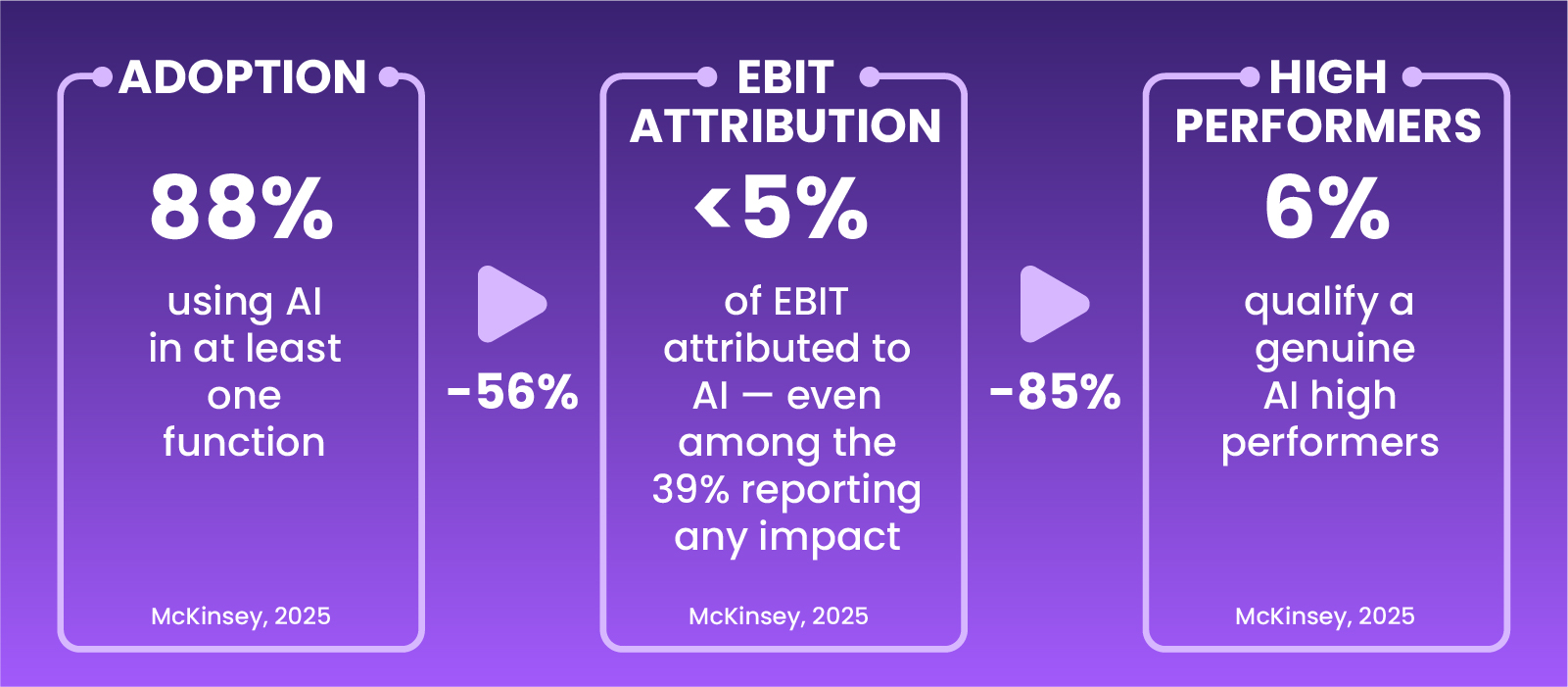
This is the plateau. Enterprise AI is generating real individual gains, call it Micro-Productivity, but those gains are not translating into the transformational outcomes boards were promised. The question is why, and the answer isn't more adoption, better models, or bigger budgets. It's structural.
What is Micro-Productivity? And why can't it scale?
Micro-Productivity is real. Sarah preparing a better brief in twelve minutes instead of two hours. An engineer vibe coding a feature in a session that used to take a sprint. A legal analyst reviewing a contract in thirty minutes instead of three hours. Early adopters surveyed by Gartner reported a 22.6% productivity improvement and 15.2% cost savings at the use-case level. McKinsey's research on AI-assisted coding found 46% time savings on routine tasks. These are genuine gains. The tools are working.
The ceiling appears the moment the work leaves the individual's hands. Follow Sarah through her full day and the pattern becomes clear.
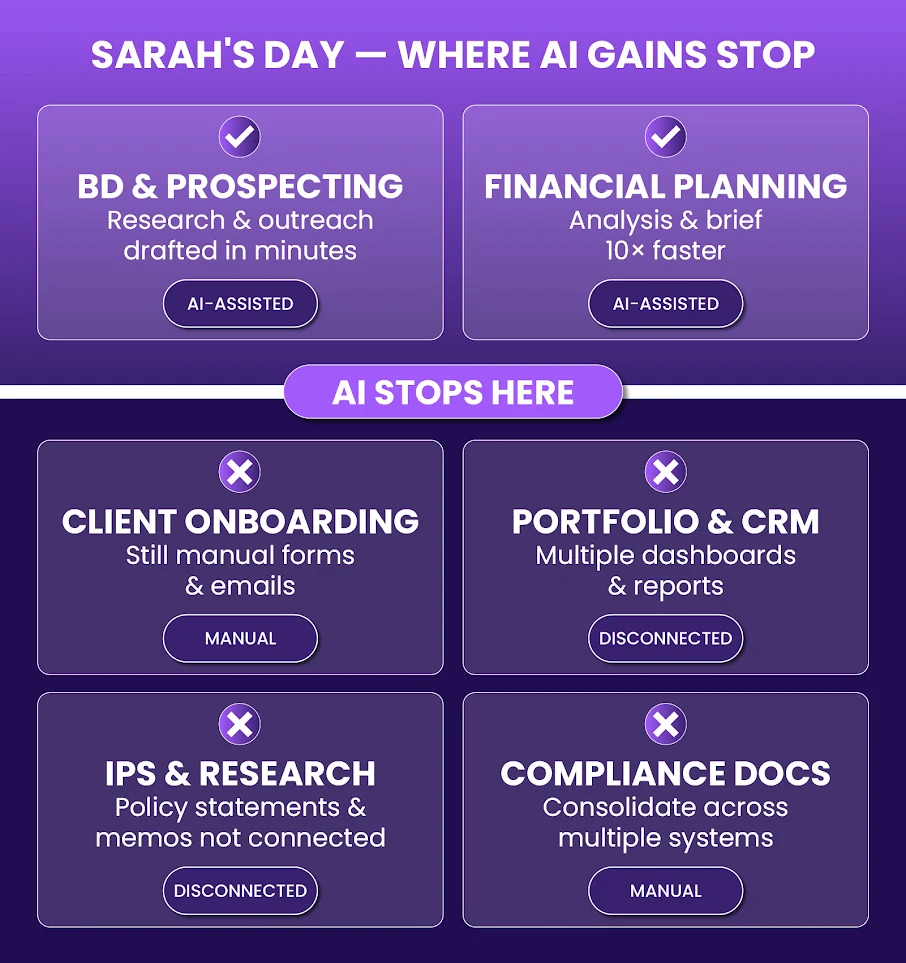
Sarah is genuinely more productive. And the business is exactly where it was. This is not a coincidence. It is the shape of Micro-Productivity: gains that are real, but isolated. The ceiling is structural, not a volume problem, and it has three causes. First, data is not accessible: Sarah's AI tools cannot see her CRM, her Investment Policy Statements (IPS), or her research notes. Every task starts from a blank slate because the knowledge the firm holds is not connected to the tools she uses. Second, learning does not compound: when Sarah works through a compliance case today, that knowledge disappears. When she closes a deal next month, there is no institutional recall of what worked. There is no memory between tasks, no context carried across clients, no intelligence that accumulates across the organization. Third, governance is not built in: compliance documentation is assembled manually from multiple systems after the fact, rather than being embedded in the workflow from the start. Every recommendation Sarah makes requires a separate, manual effort to justify and record, work the AI cannot touch because it was never connected to the process. Adding more AI tools does not fix any of this. The AI made Sarah's tasks faster. The enterprise is still operating without a memory, without connected knowledge, and without governance that keeps pace with the work.
Revenue does not grow because a proposal was written faster. Customer experience does not improve because a relationship manager was better prepared for one call. Those outcomes require decisions that compound, knowledge that persists, and organizational learning that carries forward across every step of the process, none of which individual AI tools are designed to provide.
The gap in Enterprise AI to push beyond the plateau
The question is not whether Sarah's AI is working. It is. The question is what would need to be true for the rest of that flow (the compliance review, the onboarding, the portfolio review, the client experience) to become as capable as Sarah is in that first twelve minutes. And the answer is that three things were never built.
Data was never made accessible. The knowledge that makes an enterprise valuable (compliance policies refined through regulatory experience, client history accumulated over years, the operating logic encoded in workflows) lives in disconnected systems, unstructured documents, and people's heads. Every time Sarah opens a chat window, the AI starts from zero. It reasons over generic patterns rather than the firm's organizational truth. The compliance team operates from a different system. The portfolio data lives somewhere else. Nothing connects.
Learning was never compounding. When Sarah figures out the right way to handle a complex client situation, that insight stays with Sarah. When she leaves, it leaves with her. Every edge case resolved, every correction made, every nuanced judgment, lost when the session closes. The organization does not get smarter from the AI. Only the individual in that session does. Without an intelligence layer that captures what was figured out and carries it forward, enterprise AI has no institutional memory. It cannot get better at being your business over time.
Governance was never built in. Before any AI can touch compliance sign-off, onboarding, or portfolio decisions, the enterprise needs to know: what did it decide, why, who authorized it, and whether it applied the right policy. That is not a legal nicety. It is the precondition for deployment. Without a layer that enforces policy at execution time and makes every decision auditable, production deployment stays blocked, and the AI stays confined to the tasks that don't require it to touch anything consequential.
The questions that kill AI pilots: Where does the model store what it learns? Who can audit what it decided and why? What happens when it touches a workflow that sits across three systems and two departments? How do we ensure it applies our policies, not a generic approximation of them? Can we show this to the regulator?
They are the structural conditions every serious enterprise deployment has to meet, and individual productivity tools are not designed to meet them. The research confirms the pattern. Gartner predicted that at least 30% of generative AI projects would be abandoned after proof of concept, citing poor data quality, inadequate risk controls, and unclear business value. A more recent Gartner forecast puts the agentic AI cancellation rate at over 40% by end of 2027, for the same reasons. Deloitte's 2026 State of AI in the Enterprise report found that only 21% of organizations have a mature governance model for agentic AI. The graveyard of stalled pilots is not full of bad AI. It is full of good AI that had nowhere to go.
What enterprise AI can actually unlock
Every major technology wave has redefined what enterprises can do, not just how fast they can do it. Systems of Record digitized data. Systems of Process automated repetitive tasks. The current wave (Copilots, AI assistants, GenAI tools) is best understood as Systems of Intelligence: technology that helps humans think faster. Sarah's twelve-minute brief lives here. It is real, it is valuable, and it is where almost every enterprise is today.
The next era is different in kind, not degree. Systems of Autonomous Execution are not tools that assist humans, they are Digital Workers that execute business outcomes end-to-end, under governance, with humans defining the objectives and supervising the results. The human role shifts from doing and deciding to directing and improving. The business outcome shifts from higher individual productivity to reliable execution at scale, outcomes the enterprise could not previously deliver at that quality and margin.
Now imagine Sarah's firm operating in that next era. Sarah still does her twelve-minute brief. But the proposal she drafts is automatically routed through a compliance engine that applies the firm's policies in real time, not in five days. Client onboarding triggers from the signed proposal. The portfolio review connects to the CRM and surfaces the client's full history. Every decision is logged, auditable, and feeds back into the platform so each subsequent interaction starts from a stronger position. Sarah is not faster. The firm is more capable, at a scale and margin structure that was not previously possible.
CEOs understand the magnitude of this shift. A Gartner survey of 469 CEOs found that 80% expect AI to force a high or medium degree of change to their operational capabilities, not their task tooling. Today, 54% say their automation is limited to specific tasks. By 2028, only 13% expect to remain at that level. The direction of travel is clear. The constraint is not ambition. It is architecture, and specifically, the absence of the cognition layer that makes Systems of Autonomous Execution possible.
The cognition layer that makes it possible
Closing the gap between Micro-Productivity and enterprise-level outcomes requires three layers, and they have to work as an integrated system. Addressing one without the others produces a more sophisticated version of the same problem.
1. Knowledge Layer
Your AI needs to know how your business actually operates. Not as a description you give it in a prompt, but as a structured representation of your data systems, policies, and workflows, encoded in the platform and maintained as your business evolves. This is the organizational intelligence layer: the unique operating logic of your enterprise, accessible to every Digital Worker that runs on the platform.
A growing number of enterprise AI pilots have stalled not because the underlying models underperformed, but because the knowledge layer was never built. The model is capable, it just did not know the business.
2. Memory Layer: intelligence that compounds
An enterprise that learns through AI should get more capable over time. Every decision the platform supports, every correction a human makes, every edge case that surfaces and gets resolved, should make the next interaction more accurate and relevant. The memory layer captures this, carrying reasoning from one case into the next, rather than starting fresh every session.
This is institutional memory, not conversational memory. The unit it captures is not what was said, it is what was figured out. And it belongs to the enterprise, not to any individual who happened to be in the session. The learning stays inside the organization, compounding into capability that no individual departure can erase.
3. Governance
Enterprise AI without governance is a liability, not an asset. The decisions AI systems make have to be auditable. The actions they take have to be explainable. The policies they apply have to be enforced at execution time, not reviewed retrospectively after something has gone wrong. The platform's continuous Evaluations go further: monitoring agent behavior against defined quality and policy thresholds in real time, and capable of stopping a process from executing before a flawed or non-compliant decision propagates downstream. This is proactive intervention, governance that acts before the damage is done.
Governance is also what unlocks production deployment. Only 21% of organizations have a mature governance model for agentic AI. Roughly 80% lack the audit trails, real-time monitoring, and clear agent boundaries that production deployment requires. A governance layer that provides those capabilities is not a compliance add-on. It is what transforms an impressive pilot into a system the business can actually deploy.
NeoSapients' Enterprise Cognition Platform brings all three layers together into a single trust boundary around enterprise AI. The Knowledge Mesh structures and surfaces what your organization knows. The Memory Layer ensures that every decision, correction, and insight compounds within the platform, not leaking to external models or evaporating at session end. The Governance Layer enforces policy at execution time, with Evaluations that can stop a process before a non-compliant decision propagates. Together, they create the conditions for business outcomes that actually move the board-level metrics, delivered by Digital Workers operating entirely within your enterprise perimeter, where your proprietary knowledge stays, accumulates, and becomes an advantage no competitor can replicate by subscribing to the same tools.
Sarah is still going to open her AI assistant tomorrow morning. That twelve-minute brief is not going away. The question is whether, by the time that client's proposal reaches compliance, gets approved, triggers onboarding, connects to portfolio management, and closes as a satisfied account, the rest of the enterprise is as intelligent as Sarah was in that first moment. That is the gap. That is what the cognition layer is for. And that is the difference between Micro-Productivity and the outcomes your board is still waiting for.