Institutional Memory Is the AI Problem, and Enterprises Are Solving It Backwards
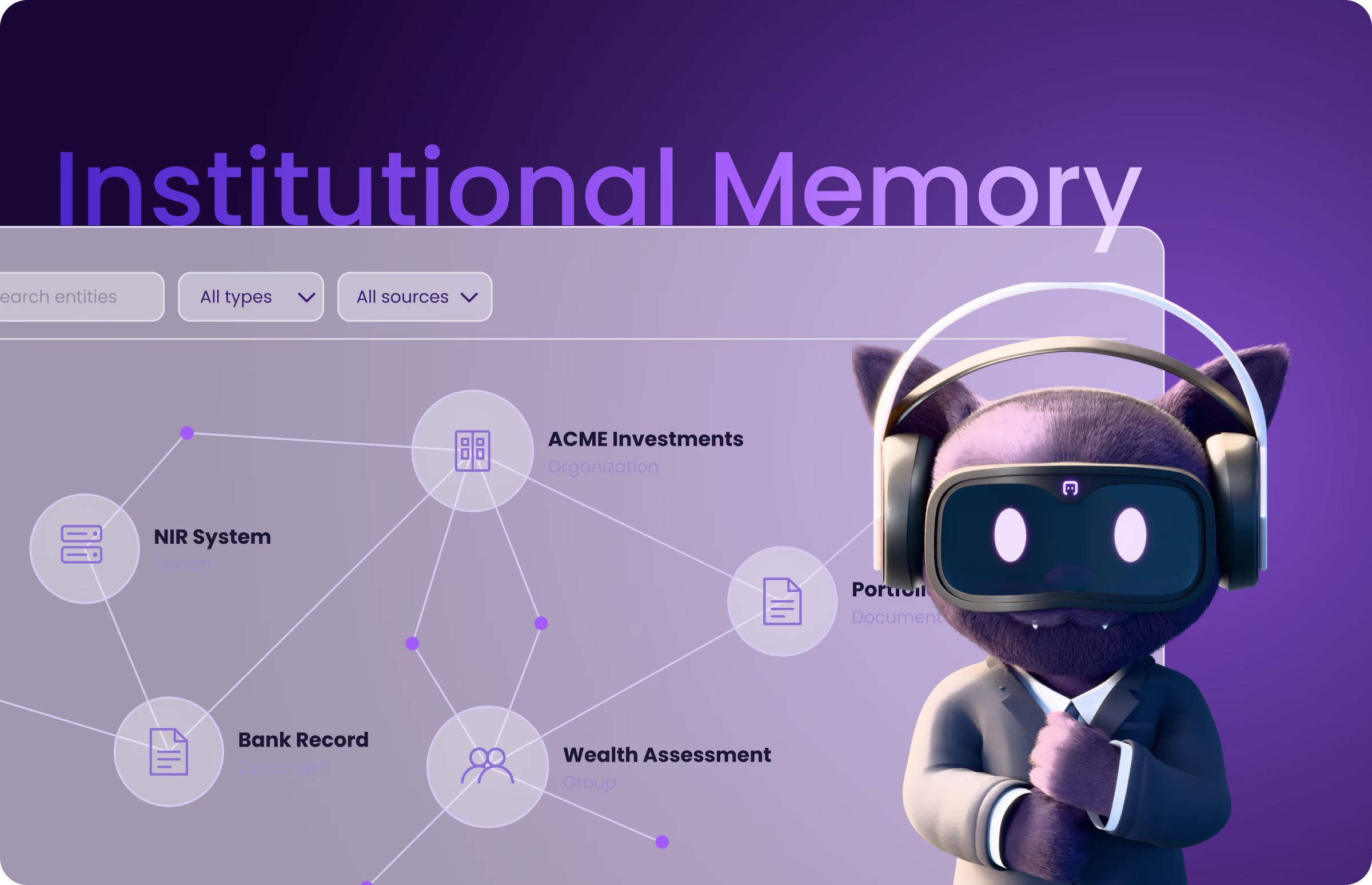
Why the AI memory race is solving the wrong problem for the enterprise, and what the right one looks like.
“What separates a mature enterprise from a greenfield one is what it has learned. What separates a useful AI from a generic one is whether it can draw on that learning.”
Problem every enterprise faces
Enterprises have a memory problem that predates AI, and AI has made it harder to ignore.
Enterprise memory problem is not whether your AI chatbot remembers your last conversation. It is whether your institution can retain and reuse the reasoning behind its decisions, the judgment that walks out the door when experts leave. Most AI memory tools address conversational continuity for the user. The problem that costs you is institutional. Institutional memory must be scoped to the enterprise, owned by the institution, and built into the reasoning engine, not bolted onto an assistant.
For CIOs, CTOs, heads of AI, and risk leaders in wealth management, banking, and healthcare who are tired of “AI copilots” that forget how their businesses make decisions.
If you’ve ever watched a senior practitioner retire and the institution lose a competency, you know the feeling. The cases they handled are still in the system. The documents are still compliant. The transactions are still on the books. But the reasoning that made any of it work was left with them. You inherited the records. You did not inherit the judgment.
Every regulated enterprise of meaningful scale runs on a deep reservoir of accumulated know-how. The methodologies your senior people apply. The patterns your experienced operators recognize. The precedents from cases that fit no rulebook. This reservoir is what separates a mature firm from a greenfield one. In most enterprises, it is also almost entirely unrecorded. That intelligence lives in individual heads, in scattered email threads, and in conversations nobody captures. When a senior practitioner walks out the door, a meaningful share of your institution’s reasoning walks out with them. When a junior person walks in, they inherit the data and the documents, but not the judgment.
This is the memory problem that matters in the enterprise. It is not whether your AI assistant remembers your name or last week’s conversation, the industry is converging on that quickly, and a growing set of players are solving it well. The harder problem, the one that consumer-shaped AI memory cannot reach, is that your institution loses what it learns nearly as fast as it earns it.
The shape of it is one any seasoned operator recognizes:
A wealth advisor at a private bank inherits a client review involving a concentrated stock position, an upcoming liquidity event, and complex philanthropic goals. A senior advisor handled a strikingly similar case last year, the right structuring, the right sequencing, the right way of bringing the family along through an emotionally fraught decision. The transactions sit in the CRM. The documents sit in compliance. The holdings sit in the books. But the reasoning that made the work succeed, why a five-year giving window rather than ten, why a donor-advised fund rather than a private foundation, how the spouse was brought around to a structure she initially resisted, lived only in the senior advisor’s head, and the senior advisor retired last month.
.png)
Multiply that across the practice. Across the institution. Across years. We call this the AI Cognition Gap: the distance between what enterprise AI promises and what it actually delivers when institutional reasoning is missing. It is the face most enterprise AI investment is failing to address.
The memory conversation everyone is having is the wrong side.
Most AI memory products solve part of the problem. Enterprises need more.
A serious cohort of companies is doing important work on AI memory. Mem0, Letta, Zep, and others are building infrastructure that enables agents to remember across sessions, maintain state across tool calls, and personalize interactions for individual users. The work is rigorous, the engineering is real, and for the use cases these systems target, agent personalization, conversational continuity, and multi-turn task completion, they are delivering. But the enterprise’s memory problem is not what these systems solve. It is not about giving an assistant a longer attention span. It is not about threading sessions for a single user. It is about whether the institution itself, across people, across teams, across years, can hold and draw on the reasoning it has developed.
Three differences matter, and none of them is stylistic.
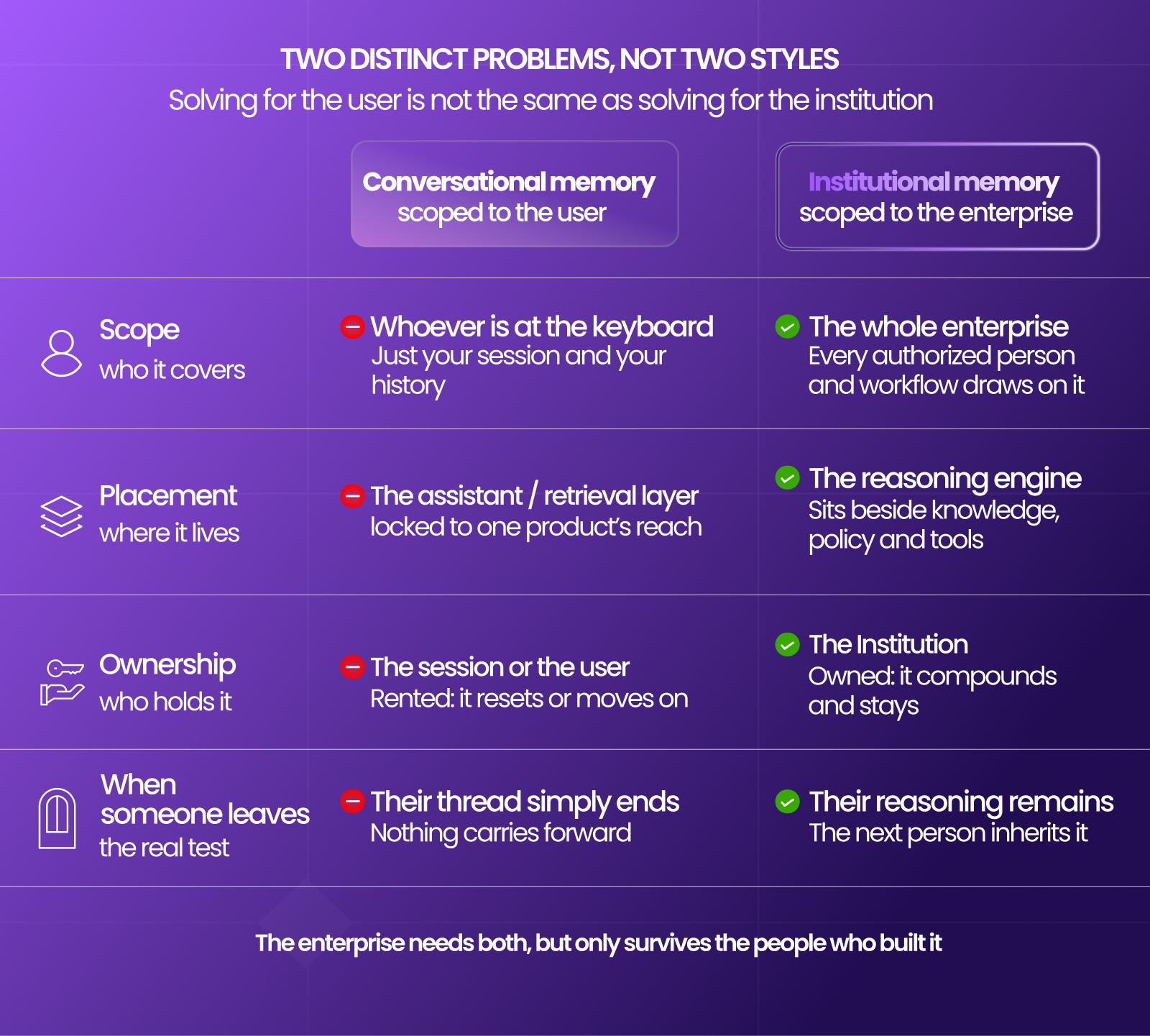
Scope
Conversational memory is scoped to whoever happens to be at the keyboard. Institutional memory has to be scoped to the enterprise, to every authorized person, to every workflow, and to every interaction with the platform.
Placement
Conversational memory lives in the assistant or its retrieval layer, at the application surface. Institutional memory has to live in the engine that reasons over your enterprise, alongside the knowledge and policy substrate the AI already draws on. Otherwise, it is locked to a single product’s reach.
Ownership
Conversational memory belongs to the session or to the user. Institutional memory must belong to the enterprise, surviving departures, transferring across teams, accumulating into something the institution owns rather than something any individual rents.
These are not gaps in the memory products on the market. They are decisions about what those products were built to do. Solving for individual user continuity and solving for institutional-scale memory are two distinct categories of problems. The enterprise needs both. They are not the same system.
What institutional memory actually looks like
Memory means something specific in the enterprise.
If memory is to do real work in an institution, if it is to capture what your senior people know and make it available to the next person who needs it, four properties have to hold. None of them is addressed by conversational memory. All of them are non-negotiable.
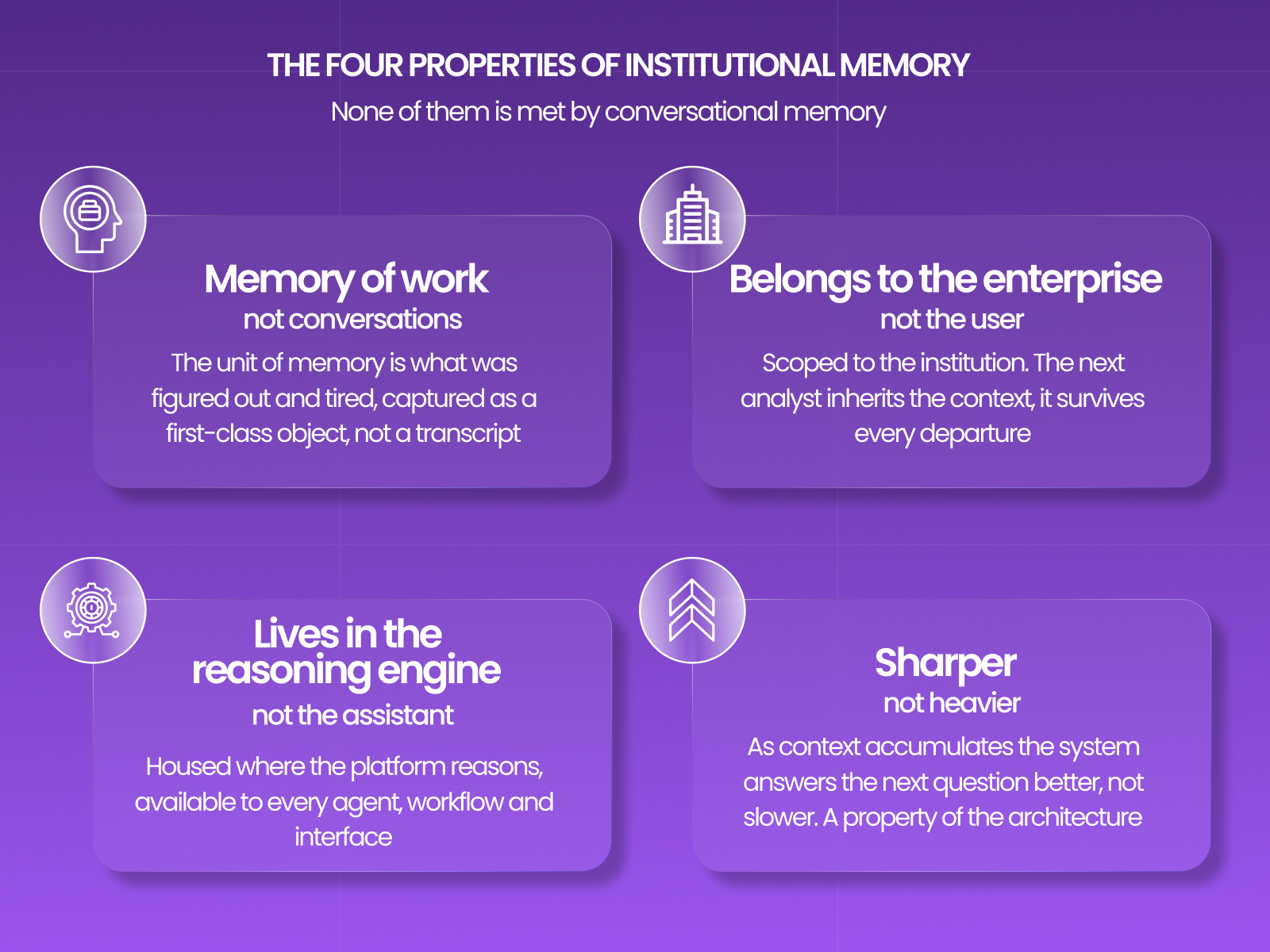
1. Memory of work, not conversations
The unit of memory is not what was said. It is what was figured out, what was tried, what worked, and what didn’t. A senior advisor’s value is not in the words they use with a client; it is in the approach they took to the problem behind the conversation. Institutional memory captures that approach as a first-class object, not as a transcript wrapped around it.
2. Belongs to the enterprise, not the user
Institutional memory cannot be scoped to whoever happened to be at the keyboard. When the next analyst picks up the work, they inherit the context. When a new team joins the platform, they walk into a system that already understands how the business operates. The memory belongs to the institution, not to any individual within it.
3. Lives in the reasoning engine, not the assistant
This is the structural choice that matters most. Memory housed in the assistant, inside a chatbot, inside a copilot, inside any one product, is locked to that product’s reach. Memory housed in the reasoning engine that sits alongside the enterprise’s data, documents, tools, and policies is available to every agent, every workflow, and every interface that draws on the engine.
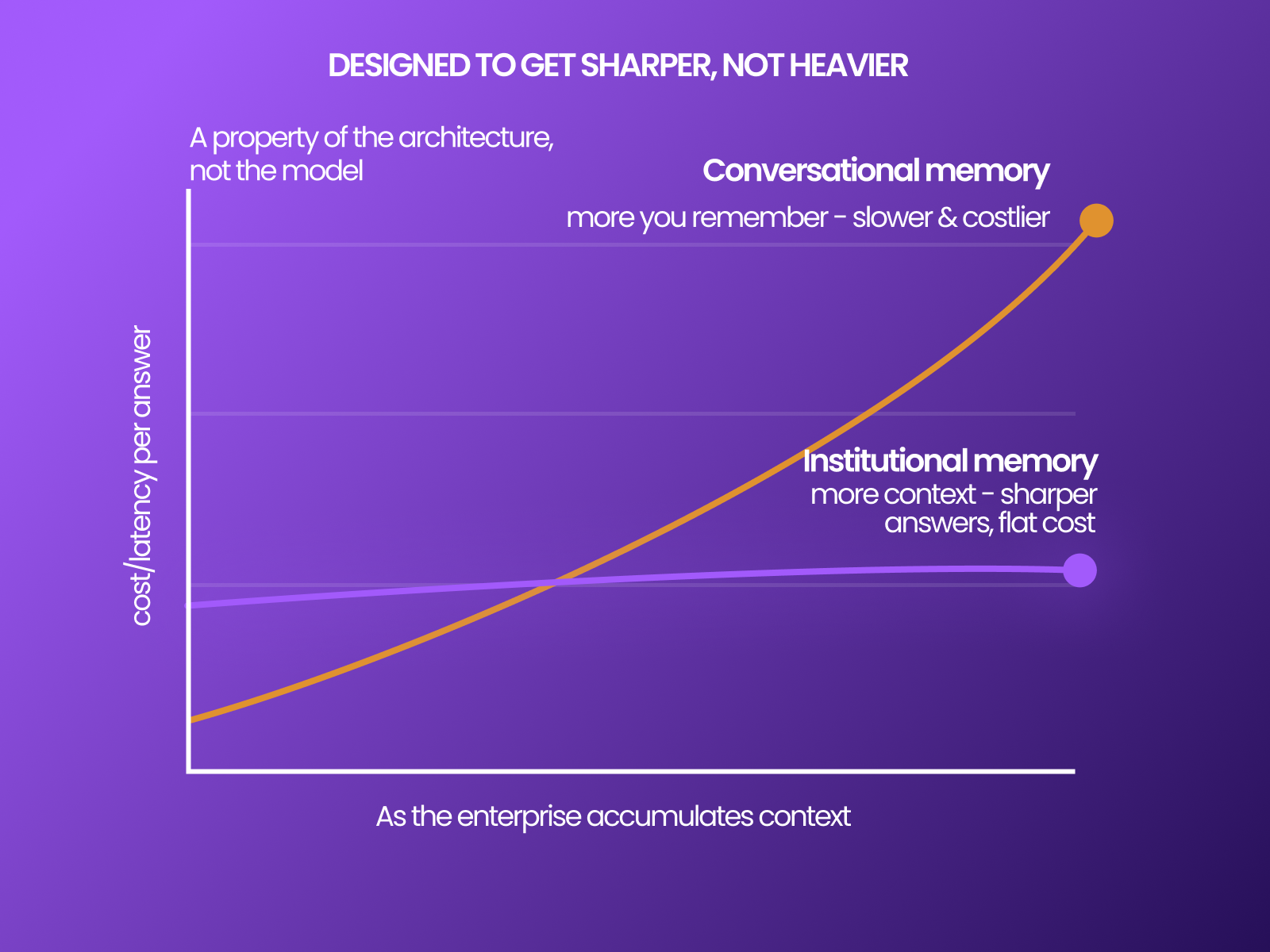
4. Designed to get sharper, not heavier
Conversational memory has a physics problem: the more you remember, the slower and more expensive every interaction becomes. Institutional memory has to work the opposite way. As the enterprise accumulates context, patterns from how cases have been handled, methodologies that have proven reliable, precedents from edge cases that have come up, the system has to get better at answering the next question, not slower at it. That is a property of the architecture, not the model.
Each of these properties is structural. None of them can be retrofitted by a longer context window, a smarter retrieval layer, or a better assistant. The system that holds institutional memory has to be designed for it from the start.
Memory belongs in the reasoning engine, not the assistant
Where memory lives determines what memory can do.
Every AI memory implementation must decide where memory lives, at the application surface, the assistant, the chatbot, the copilot or at the reasoning layer, the engine that draws on enterprise data, policy, and context to produce answers.
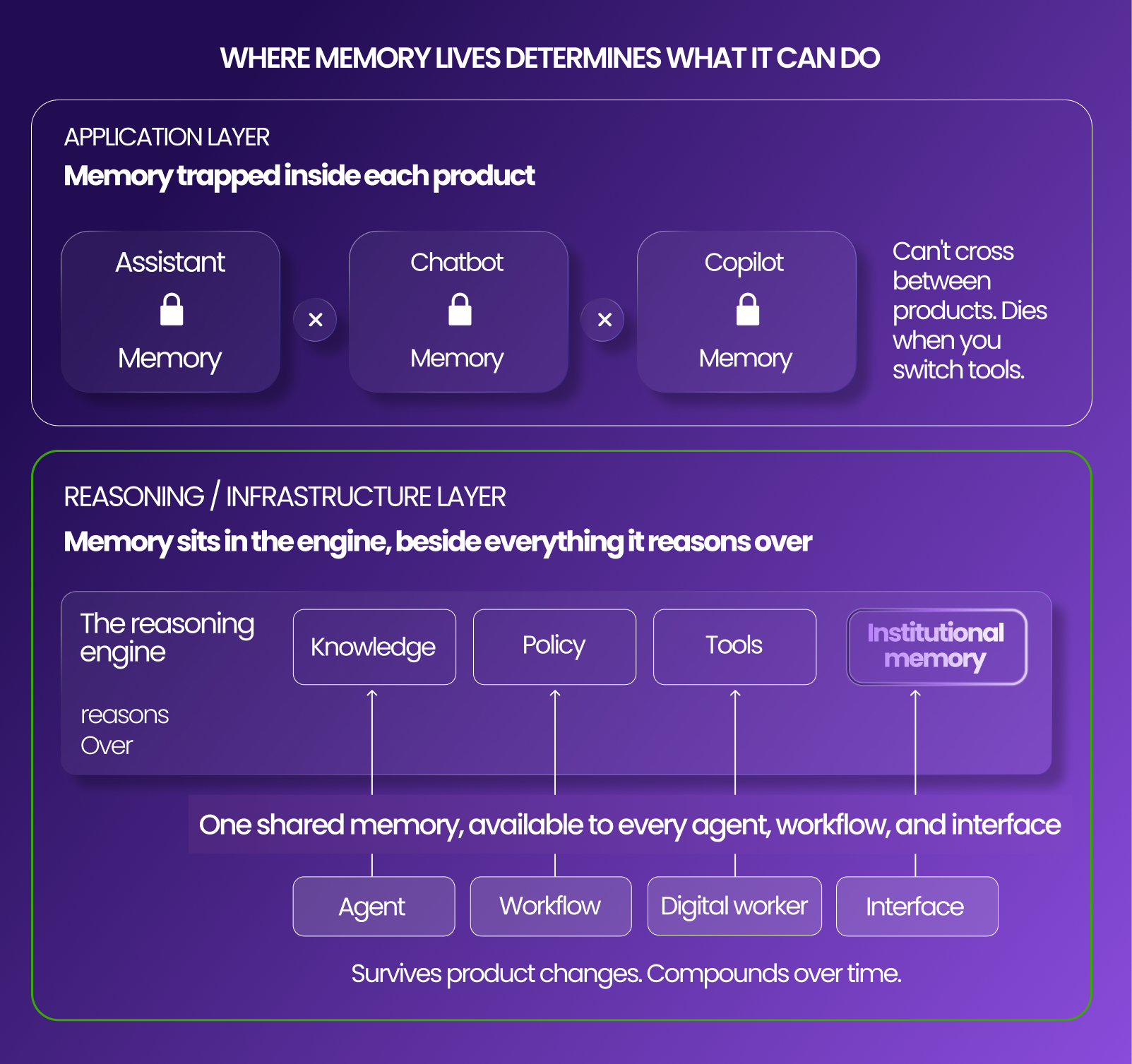
This is the positioning move the memory category has not yet made. The reason it has not is that the memory category has been built as a sidecar product, a thing you add to your AI assistant. The enterprise’s memory problem requires the opposite move. Memory has to be a capability of the reasoning layer, not a product that sits next to it.
Institutional memory, By Neosapients
NeoSapients platform closes the AI Cognition Gap across three layers, delivered by three modules. Knowledge Mesh holds your enterprise’s data, documents, tools, and accumulated context. Cortex Engine is the reasoning engine that draws on it. The Outcome Ledger captures and governs every decision made on top of it. Knowledge Mesh addresses the first two properties memory of work, not conversations, owned by the institution. Cortex Engine satisfies the third memory in the reasoning layer, not the assistant. The Outcome Ledger delivers the fourth every decision compounds the system, making it sharper rather than heavier. Each module compounds the value of the others; together they make accountable digital workers possible.
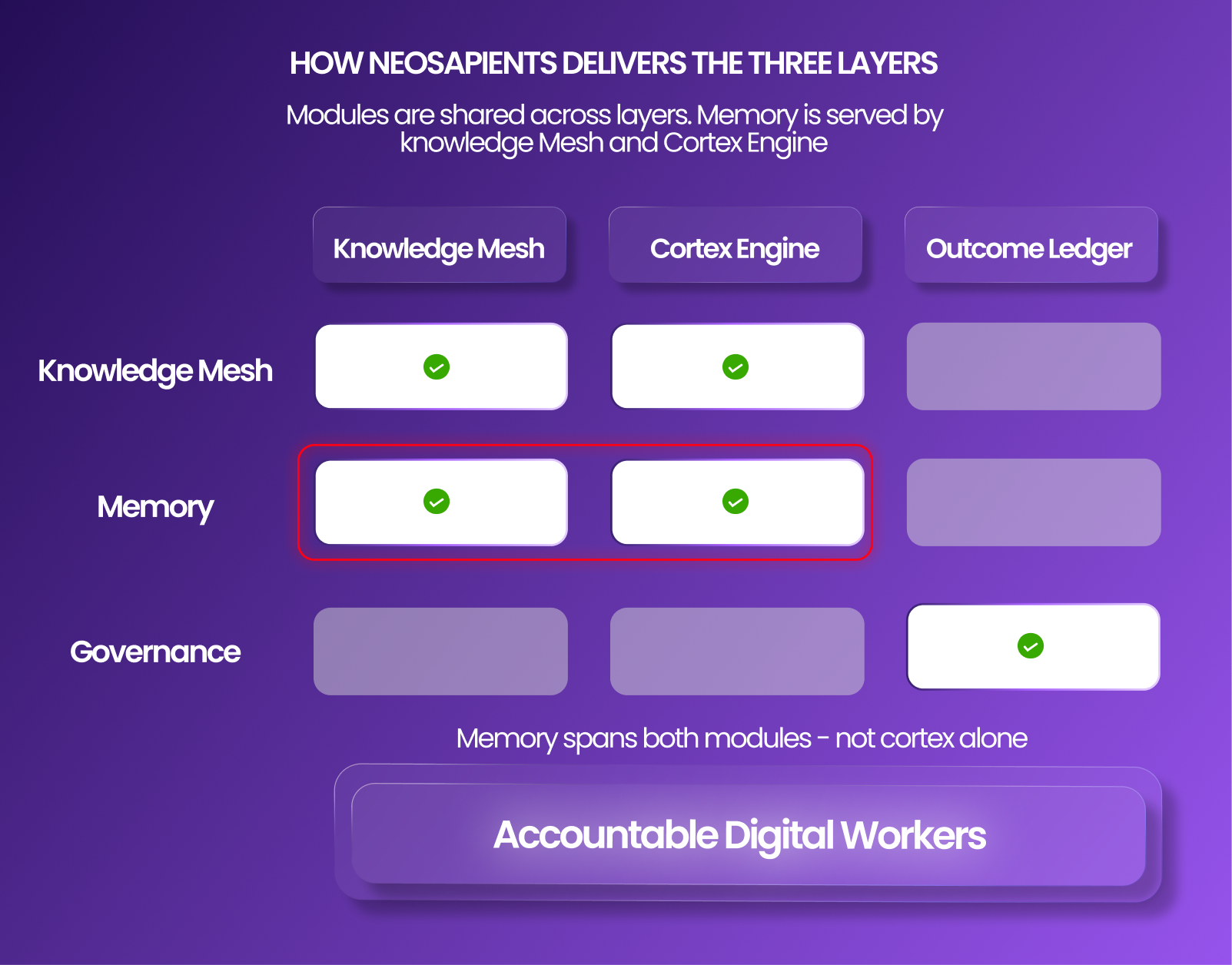
Institutional memory is served by Knowledge Mesh and Cortex Engine together. It is the part of the platform that knows when to pull forward the reasoning behind a similar case, the methodology a senior practitioner has applied before, the precedent that quietly shaped how a comparable decision was reached. It does this at the reasoning layer, not the assistant layer, so the same memory is available to every workflow, every digital worker, and every interface that draws on the engine.
This is what gives the work your senior people do somewhere to live. When the wealth advisor from section 01 inherits the client review, the platform can surface the approach the retiring advisor took on the comparable case, the structuring choice, the sequencing, and the human element. Not because the conversation was remembered, but because the reasoning was captured in the institution’s substrate, available to anyone authorized to draw on it. The substrate this is built on is the same substrate your enterprise’s knowledge and policy already live on. That is the structural advantage. Institutional memory is not a sidecar product bolted onto your existing AI stack. It is what the platform that reasons across your enterprise is already doing, the institution’s reasoning, captured and accessible, every time the engine works. What you have invested in over decades, the methodologies, the precedents, the judgment, has a place to live and a way to be drawn on. Not as data sitting in storage, but as an institutional reasoning engine that can reach a decision as soon as the next question arrives.