The Reverse Information Paradox Already Has a Solution
"You should be able to run the best models in the world without teaching them the things that make you, you. That boundary is not a policy. It is a product."" ~ NeoSapients
Kenneth Arrow's information paradox, reversed
Kenneth Arrow's information paradox is well understood: a seller of knowledge can't prove its value without giving it away for free. Satya Nadella recently pointed out that AI has produced the reverse image of that problem. To get real value from a model, an enterprise must hand over the very knowledge that makes it unique its workflows, its corrections, its judgment calls. Nadella calls this the Reverse Information Paradox.
Where we'd push back is on the idea that it's unsolved.
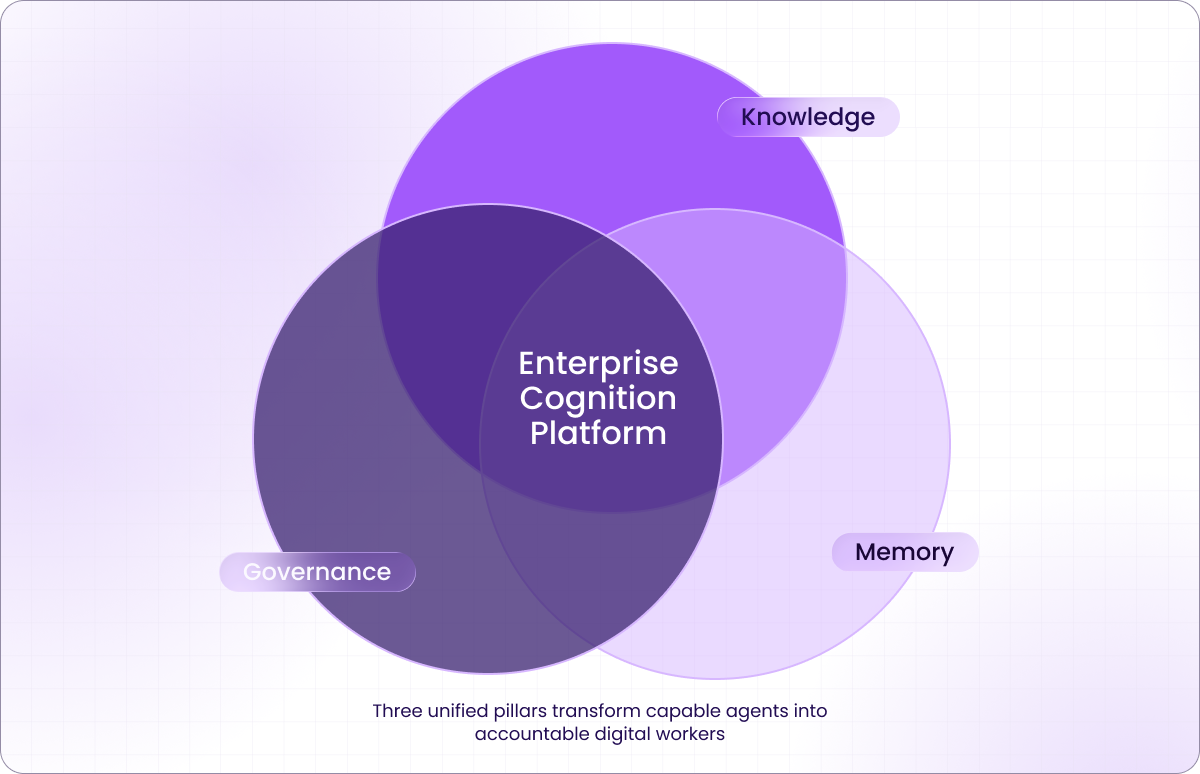
NeoSapients is the Enterprise Cognition Platform. A unified layer of knowledge, memory, and governance built to give a firm control over its own learning loop, within its own boundary.
The exhaust problem
Models learn from usage "exhaust" . The prompts people write, the tools agents use, and especially the corrections people make. Every correction is distilled into institutional know-how a competitor could never buy, and it leaks imperceptibly: trace by trace, correction by correction, eval by eval. ~ Paraphrased from Satya Nadella's post on the Reverse Information Paradox.
Where NeoSapients builds on it
This is the exact failure mode the AI Cognition Gap describes. Point solutions bolt memory without the knowledge layer onto a model that lives outside your boundary, so the thing that's supposed to make your AI smarter is quietly making someone else's model smarter instead. Closing that gap requires knowledge and memory layers to operate as a single substrate within the enterprise.
To be clear, we still use and rely on frontier LLMs. That's not the part we think enterprises should reinvent. What changes is the boundary within which the model operates. NeoSapients runs entirely within your security boundary, backed by Zero Data Retention clauses with every model provider we connect to, so prompts, corrections, and outputs are never retained or trained on downstream models. NeoSapients ensures usage exhaust never becomes someone else's training signal, and instead builds compounded knowledge within your ecosystem.
The trust boundary
Patents let an inventor disclose without giving the idea away for free. The Reverse Information Paradox needs its own equivalent: a hard trust boundary where an organization's data, traces, evals, and adapted weights accumulate together and nothing crosses that boundary without consent. He frames this as every firm's right to align models to its own accountability obligations. ~ Paraphrased from Satya Nadella's post; he also cites Alex Karp's point that technical customers want ownership of their compute, models, data stack, and alpha.
Where NeoSapients builds on it
That boundary is the actual product we build. As the Enterprise Cognition Platform, Knowledge Mesh, Cortex Engine, and the Decision Ledger aren't three vendors stitched together with an API key each. They're one substrate, deployed inside your tenant, where your institution's data, decisions, and corrections accumulate and compound to form the tribal knowledge without ever crossing outside the org.
And that boundary isn't a rebuild. Knowledge Mesh connects to the systems you already run and leaves your data exactly where it lives. No rip-and-replace, no re-platforming, just to get inside your own boundary.
Five things every enterprise must do
Nadella lays out five C's a firm needs to protect its learning loop: Control, Capability, Choice, Cost, Compound. Each has an owner on our platform.
Control
Own your evals, your memory, your institutional context.
The Decision Ledger captures every decision, policy, and correction as an immutable record inside your boundary and it doesn't stop at recording. It builds on learning: audited corrections and human overrides are incorporated into institutional knowledge, so the learning loop closes automatically and the same mistake is never caught twice. Private evals run directly against that same ledger, not as a one-time certification at launch. Cognition Scoring runs on our Evaluation Framework a probabilistic query score built from historic logs, an AI-and-expert-verified evaluation dataset, a four-dimensional LLM-as-judge rubric, and continuous human feedback from production so "what good looks like" stays defined by your organization, continuously, as the ledger and the learning loop both keep moving.
As Nadella frames it "Control Create your private evals, because evals define what "good" looks like inside your organization. Retain ownership of your memory, traces, feedback, decisions, and institutional context."
Capability
Build proprietary learning environments without exposing what you know.
The same Decision Ledger that captures your decisions doubles as the proprietary learning environment itself. Because every correction and outcome is already captured and promoted inside your boundary, agents are refined directly against that accumulated record real workflows, real corrections by giving them better context, not by retraining a model, and none of it ever leaves your tenant. And the ledger doesn't just store what it captures: it updates. Each new decision is checked against what's already known, so the institutional knowledge underneath it keeps getting more accurate rather than sitting frozen at whatever it looked like on day one. The learning environment isn't a separate product bolted on afterward. It's the ledger that recorded the decision, now sharpening the context behind the next one.
As Nadella frames it "Capability Build your own proprietary learning environments within the tenant boundary, so models learn against real workflows without exposing the company's knowledge."
Choice
Decouple the orchestration layer from any one model.
NeoSapients is model-agnostic from the foundation up: OpenAI, Anthropic, Google Gemini, xAI Grok, or custom models because the institutional memory and governance logic live in the Intent Engine and Decision Ledger, not inside any single model's weights. Swap the model. Retain your institution's knowledge.
As Nadella frames it "Choice Decouple the orchestration layer from any single model. If that model were taken away, would your "veteran" capability survive without the "generalist" that held it?"
Cost
Route context, models, and tasks efficiently without sacrificing quality.
Cortex Engine delivers just-in-time memory orchestration: the right knowledge to the right model at the right moment. Plan caching adds a second lever: once a decision path has already been reasoned through, similar future requests reuse that cached plan instead of paying for full inference again. Because routing is decoupled from any single provider, you're free to combine models, context, and cached plans in the most cost-effective configuration for a given task.
As Nadella frames it "Cost Decoupling the orchestration layer lets you combine context, models, and tasks in the most efficient way, without sacrificing quality."
Compound
Turn the learning loop into a hill-climbing machine.
NeoSapients is the Intelligence Loop every outcome feeds back into Knowledge Mesh, so the system gets smarter with every deployment.
As Nadella frames it "Compound Bring Control, Capability, Choice, and Cost together and you create a continuous learning loop a "hill climbing machine" that compounds your AI investment into firm value."
The actual question
As Nadella frames it "In the cloud era, enterprises accumulated data. In the AI era, they accumulate learning. The trust boundary must evolve accordingly from protecting information to protecting the mechanisms through which organizations learn, adapt, and compound intelligence."
Where NeoSapients builds on it
That's a bigger ask than data residency, and it's the reason NeoSapients was built as a single cognition layer rather than three adjacent tools. Knowledge without memory is brittle. Memory without governance is dangerous. Governance without knowledge is hollow. You need all three, inside one boundary, before the loop is actually yours.
Use the best model in the world; keep the knowledge that makes you unbeatable. This is the state NeoSapients is built to run, the Enterprise Cognition Platform putting each of these principles into practice, inside your boundary.