From Knowledge Graphs to Knowledge Mesh
The enterprise knowledge problem is not whether AI can find the right document. It is whether it can reason across the many kinds of knowledge a real decision requires: operational data, the policy that governs it, the methodology a senior practitioner would apply, the tool that computes the answer, and the precedent set the last time a case like this came up.
Knowledge graphs give AI structure without guidance. Retrieval gives it passages without context. Neither gives it a fabric it can reason across. That fabric is a Knowledge Mesh.
If you have funded a knowledge graph, watched it go live, and then watched your AI initiative stall anyway, you know the feeling. The entities are modelled. The relationships are typed. The data quality is better than it has ever been. And the AI still cannot tell you whether to approve the case. You built the map. You did not build the reasoning.
The knowledge layer enterprise AI still does not have
Most enterprises have a knowledge graph project somewhere in their history. Some are running quietly in production, serving up entity lookups. Some are halfway built and waiting for executive sponsorship. Some are quietly archived: beautiful in design, expensive to maintain, and never quite delivering on what was promised.
It is not that knowledge graphs were a bad idea. It is that the problem moved.
When you point an AI agent at an enterprise knowledge graph, something uncomfortable becomes clear. The AI can fetch records and traverse links, but it does not know what to do with them. It cannot tell which knowledge matters for which question, how different kinds of knowledge fit together, who is allowed to see what, or how to reason across the messy, real-world structure of how the business actually operates.
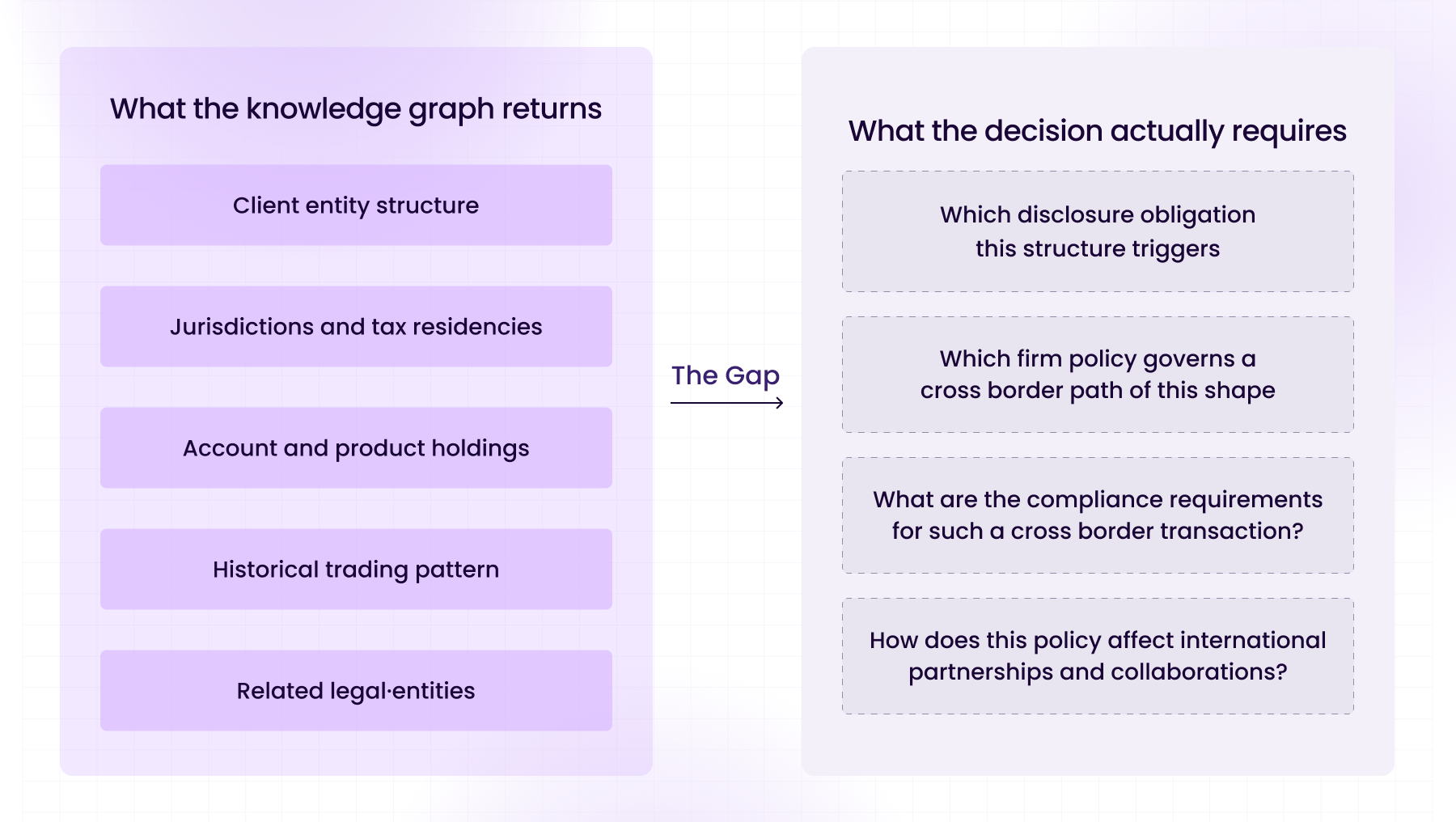
Multiply that across the practice, the institution, and every regulated decision. That is the knowledge face of the AI Cognition Gap: the gap between what enterprise AI promises and what it actually delivers.
Why traditional approaches fall short
Most AI knowledge approaches solve part of the problem. Enterprises need more.
The knowledge graph approach builds a clean, curated graph of your entities and their relationships. The result is structurally elegant and genuinely useful for what it is: entity lookups, relationship traversal, and structured queries over a well-modelled domain. But your enterprise does not store knowledge as one thing. Operational data lives in databases. Policies live in documents. Capabilities live in APIs and computational tools. Expertise lives in senior practitioners' heads. Precedent lives in email chains and case notes. Forcing all of this into a single graph schema flattens the richness that made the knowledge valuable in the first place.
The retrieval approach, or RAG, indexes everything, searches at query time, and places the most relevant passages into the AI's context. It works well for document question answering, semantic search, and content synthesis. But retrieval finds passages that look relevant. It cannot tell the AI which knowledge matters most for a decision, which sources can be trusted for which purpose, or which connections to follow in what order to reach an answer the business can defend.
The vendor harness approach is the newest entrant: platform vendors expose their own estate to AI agents through governed APIs and MCP tools, data, workflows, business logic, and permissions. Within its estate, this is useful. But it was not built to be the substrate an AI reasons across. It grants access to one platform's knowledge; it cannot tell the AI how that knowledge relates to policy in your document store, methodology in your practitioners' heads, or precedent in last quarter's case notes. Access is not reasoning, and one estate is not the enterprise.
| Capability | Knowledge Graph | RAG | Vendor Harness | Knowledge Mesh |
|---|---|---|---|---|
| Entity lookup and relationship traversal | ✓ | — | ✓ | ✓ |
| Passage retrieval from documents | — | ✓ | ✓ | ✓ |
| Multiple distinct kinds of knowledge | — | ~ | ~ | ✓ |
| Guided navigation for AI reasoning | — | — | — | ✓ |
| Access control at the foundation | — | — | ✓ | ✓ |
| Accumulates context with use | — | — | — | ✓ |
Vendor harness capabilities apply within the platform vendor’s own estate only.
These are not failings of those approaches. They are decisions about what each was built to do. A knowledge graph was built to model a domain. Retrieval was built to find relevant text. Neither was built to be the substrate an AI reasons across when a regulated decision is on the line.
Enterprise AI does not need access to knowledge. It needs an intelligence fabric it can reason across.
What is different about a Knowledge Mesh
A Knowledge Mesh is not a bigger graph. It is a different category of system, built from the start to serve AI reasoning at enterprise scale. Four properties set it apart.
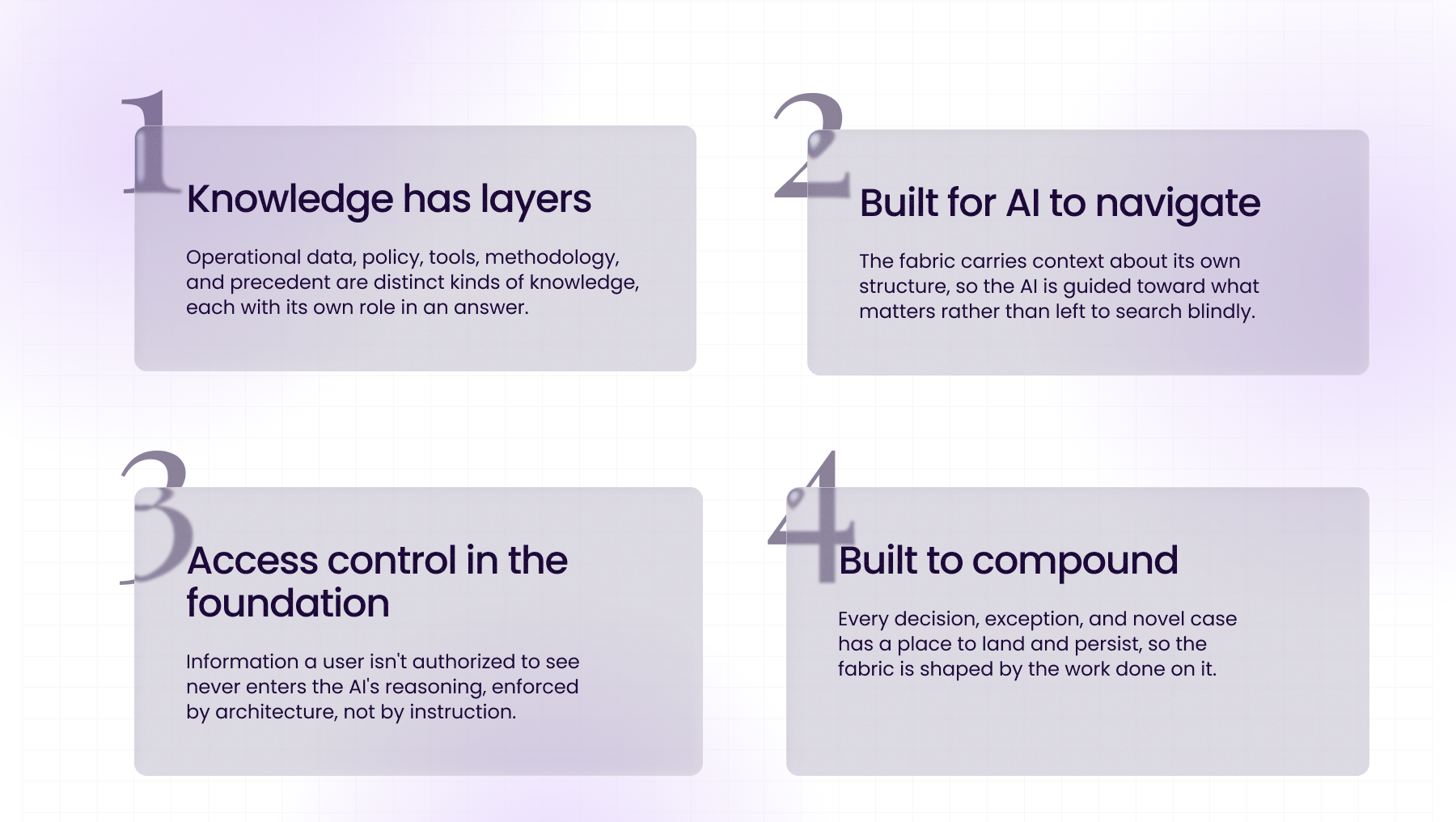
Knowledge has layers
Your enterprise does not have one kind of knowledge. It has many: operational data, policy documents, computational tools and APIs, reasoning methodologies, and the precedents your team has set while handling exceptions over the years.
A Knowledge Mesh recognises each as a distinct category, with its own structure, retrieval pattern, and role in answering a question. When AI handles a real enterprise question, it can draw from all of them: a data record, a regulatory document, a calculation tool, the methodology a senior team member would apply, and the most relevant precedent from a past decision. It can then assemble them into a coherent answer.
Built for AI to navigate, not just search
Most knowledge graphs are passive. They hold information and wait to be queried. The AI is left to work out which pieces matter, in what order, and why. That works for small graphs and simple queries. At enterprise scale, it breaks.
A Knowledge Mesh carries context about its own structure: cues that help AI understand which parts apply to a question and which do not. Navigation is guided, not blind. Over time, the way your business reasons about its knowledge can be captured in the fabric itself rather than in prompts, filters, or one-off integrations. What accumulates becomes increasingly hard to replicate from the outside.
Access control is in the foundation
In regulated enterprises, knowledge is not freely shared. A relationship manager cannot see another business unit's customer book. A claims agent cannot see another region's clinical records. A junior analyst cannot see executive-level data.
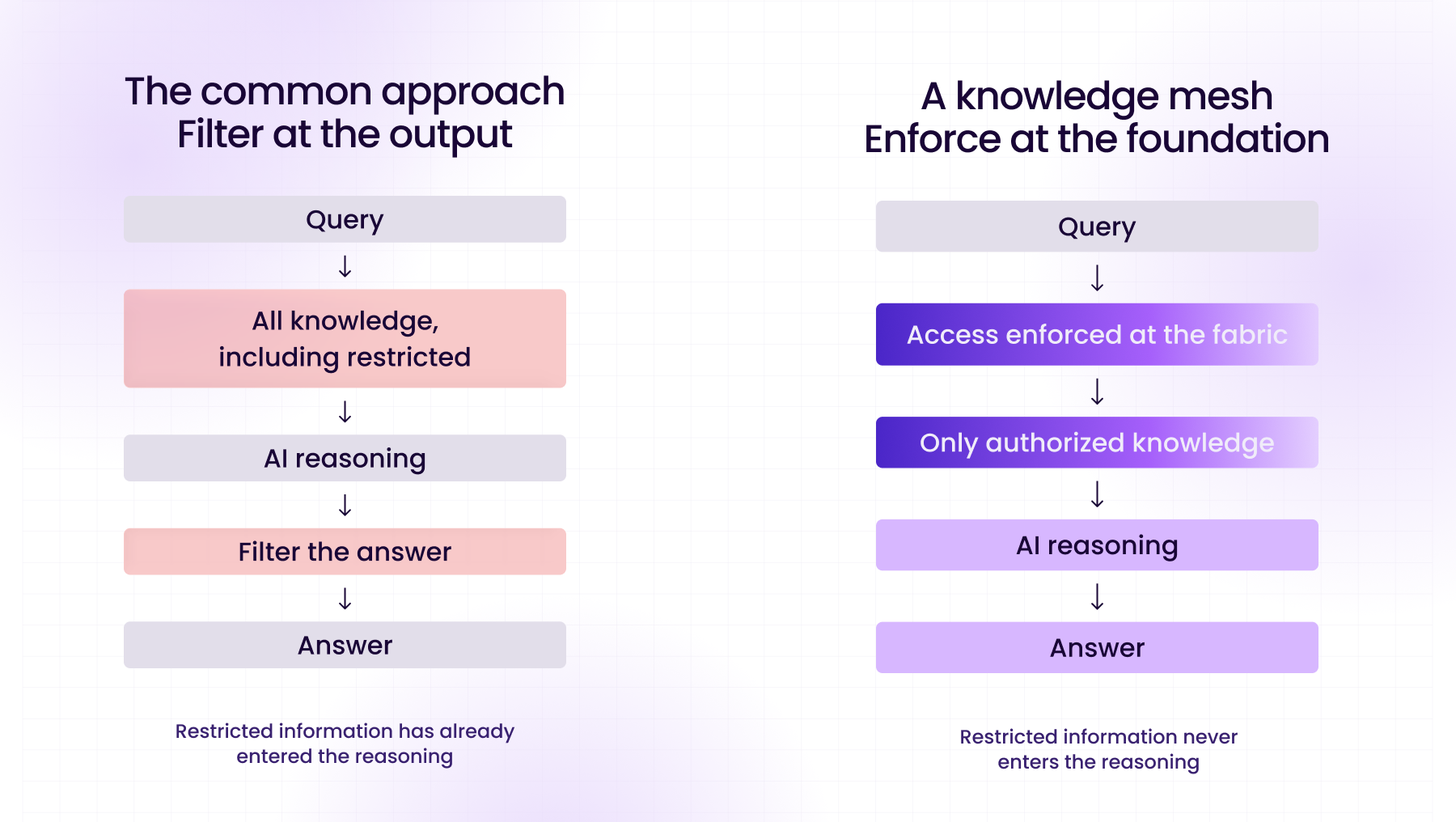
Most platforms address this with prompts and post-hoc filters: instructions telling AI to avoid certain topics, or checks for sensitive content before an answer reaches the user. The problem is structural. Once restricted information has entered the AI's reasoning, no amount of instruction or output filtering will reliably stop it from shaping the answer.
A Knowledge Mesh enforces access at the architectural level. Information a user is not authorised to see never enters AI reasoning in the first place.
Built to compound
Most AI knowledge systems are static. You set them up. They serve queries. They never get richer.
A Knowledge Mesh is built to compound. Every decision the platform reasons through, every exception your team approves, and every novel scenario senior practitioners resolve has a place to land and persist. Patterns find somewhere to live. Precedent accumulates in the fabric rather than evaporating into inboxes.
This is the substrate institutional memory is built on. The Knowledge Mesh holds what the enterprise accumulates; the Cortex Engine knows when to draw on it. Together, they let tomorrow's digital workers inherit the reasoning that came out of yesterday's decisions. An enterprise running on a Knowledge Mesh for twelve months has a materially richer fabric than one that started yesterday, not because more data was loaded, but because the fabric has been shaped by the work done on it.
Every tier of the Mesh is continuously scored against anchored ground truth, recency, and permission integrity. Those scores feed the Enterprise Cognition Score: the measure that governs what an agent is allowed to do. A mesh the enterprise cannot measure is a mesh the enterprise cannot trust.
From static graph to living intelligence
Every enterprise AI implementation makes a decision about where its knowledge lives, deliberately or by default. It may live as scattered data across databases, documents, and people's heads; as an index queried at runtime; as a graph of entities and relationships; or as a substrate the reasoning engine sits on top of, layered by knowledge type, governed at the foundation, and built to accumulate.
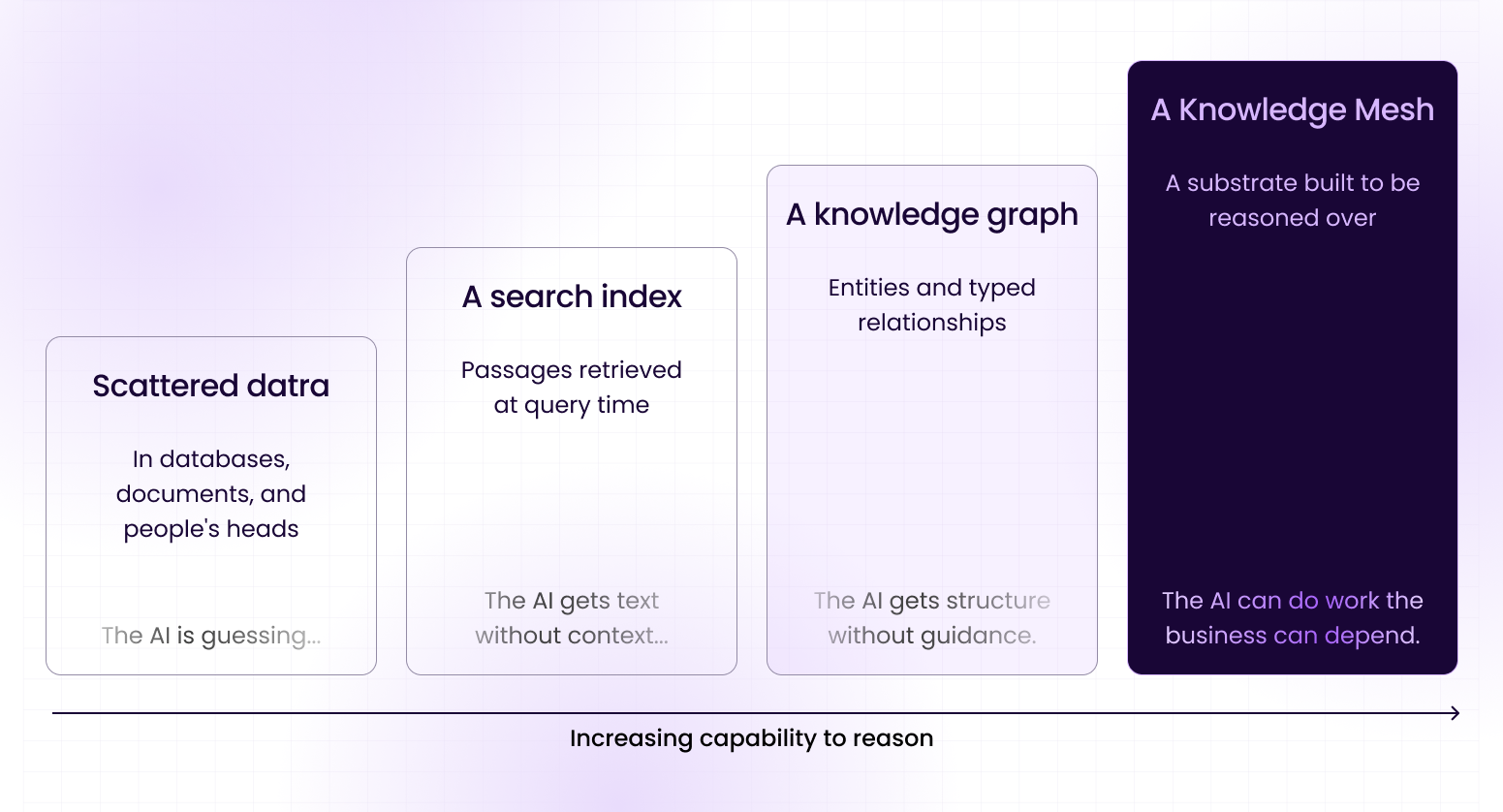
Enterprise knowledge tooling has been built to store and to find. The enterprise AI problem requires something else: knowledge must become a substrate that a reasoning engine can work across, not a repository an assistant can search.
Platform vendors have started to see this too. Their answer is the governed harness: expose the platform's data, workflows, and permissions to any agent. It is a real step, and it is confined by design to the platform's own estate. Your enterprise's knowledge does not live in one estate.
Knowledge Mesh by NeoSapients
The NeoSapients platform closes the AI Cognition Gap across three layers, delivered by three modules. Knowledge Mesh holds your enterprise's data, documents, tools, methodologies, workflows, and accumulated context. Cortex Engine is the reasoning engine that draws on it. The Outcome Ledger captures and governs every decision made on top of it. Each module compounds the value of the others; together they make accountable digital workers possible.
When AI is asked for a recommendation on a cross-border transfer, it is not navigating a flat graph of entities and accounts. It is reasoning across a fabric that connects the client structure to the jurisdictional policy that governs it, the firm's own position on cross-border paths of this configuration, and the precedent set on similar cases handled before. The data is the same. What AI can do with it is not.
This is not a layer you can buy off the shelf or assemble from existing knowledge-management tools, and it is not a layer a single platform vendor can hand you. Your enterprise's knowledge was never confined to one vendor's estate. The Knowledge Mesh is not a component bolted onto your AI stack. It is the foundation the rest of the stack stands on: the substrate where your enterprise's intelligence finally has a place to show up in AI.
Start with the right knowledge problem
The enterprises that build a fabric their AI can reason across, not just a repository it can search, build a compounding advantage their competitors cannot buy or reverse engineer.
If you lead AI, data, or architecture at a regulated institution where decisions carry real stakes, we would like to walk through your current knowledge stack and where a Knowledge Mesh fits in.