Enterprise AI Should Get Cheaper as It Learns. But It Isn’t.

As AI moves from pilots to production, inference is becoming a material enterprise cost. The answer may not be simply finding cheaper models. It may be learning when not to use a model at all.
TL;DR
- Inference keeps getting cheaper per token, yet enterprise AI bills keep rising because agentic workflows consume far more reasoning per task.
- The root cause is that most systems re-reason every request from zero, paying full price for work the enterprise has already done before.
- The NeoSapients Cortex Engine turns repeated work into institutional learning the reasoning is reused, while execution still runs live against current data.
- In benchmarking, that shifts the curve 2.11× lower inference cost and 62% lower latency and the advantage widens with reasoning complexity.
AI has a strange scaling problem.
The unit economics of AI inference have improved dramatically. For a comparable level of model capability, inference has become substantially cheaper as models, hardware, and infrastructure have improved.
But enterprise AI bills are moving in the opposite direction.
As companies move from copilots to agents, a single business request can trigger multiple reasoning cycles, retrieval operations, tool calls, validations, and model interactions. Gartner calls this the Inference Paradox: improving inference economics are being overtaken by the increasing complexity and consumption of AI workflows. Gartner predicts inference cost per agentic workflow will increase more than fivefold through 2028.
The problem is already visible inside enterprises. McKinsey's 2026 Enterprise AI FinOps research found that AI spend increases nearly fourfold as organizations move from isolated use cases to enterprise-wide adoption, with 93% of surveyed organizations reporting that they had exceeded their AI budgets.
BCG describes the underlying dynamic simply: AI consumption is growing faster than token prices are falling. This changes the economics of enterprise AI.
The obvious response is to make every inference cheaper: use smaller models, route requests between models, compress prompts, reduce context, or negotiate better pricing. All of those approaches have value. But there is another question we think enterprises should be asking:
Why are we asking the model to reason through problems it has already learned how to solve?
The hidden cost of starting from zero
Consider a Wealth Advisor asking an AI system:
Which clients show early signs of relationship risk when we combine portfolio underperformance, recent withdrawals, declining engagement, and reduced advisor interaction?
This is not a lookup.
The system first has to understand what "relationship risk" means in the context of the firm. It must identify the relevant clients, determine the right portfolio-performance measures, retrieve transaction and withdrawal activity, find engagement signals, correlate advisor interactions, apply the appropriate methodology, and construct an answer that explains why each client was surfaced.
That is exactly the kind of problem where an LLM is valuable.
It can interpret the question, reason across different types of enterprise knowledge, determine what information is required, and work out how to solve the problem.
Now imagine another advisor asks a similar question tomorrow. The clients may be different. The latest transactions will be different. Portfolio values will have moved. Engagement activity will have changed. The answer should absolutely be recomputed.
But should the AI have to rediscover the entire method for getting there? In most agent architectures, it does.
The agent once again interprets the request, reasons about the available data, determines which tools to invoke, constructs the execution sequence, evaluates intermediate results, and works its way toward the answer.
The system solved the problem yesterday. But from an inference perspective, it behaves as if yesterday never happened. This is one of the hidden costs of enterprise AI.
Agents repeatedly pay to rediscover how to perform work they already know how to perform.
NeoSapients is designed to compound institutional knowledge
At NeoSapients, we started with a simple idea: Not every request deserves a fresh chain of LLM reasoning.
When a problem is genuinely new, probabilistic reasoning is extremely valuable. But once the platform has established a reliable and validated way to solve a class of problem, repeatedly asking an LLM to reconstruct that process is inefficient.
So we designed NeoSapients Cortex around three complementary capabilities:
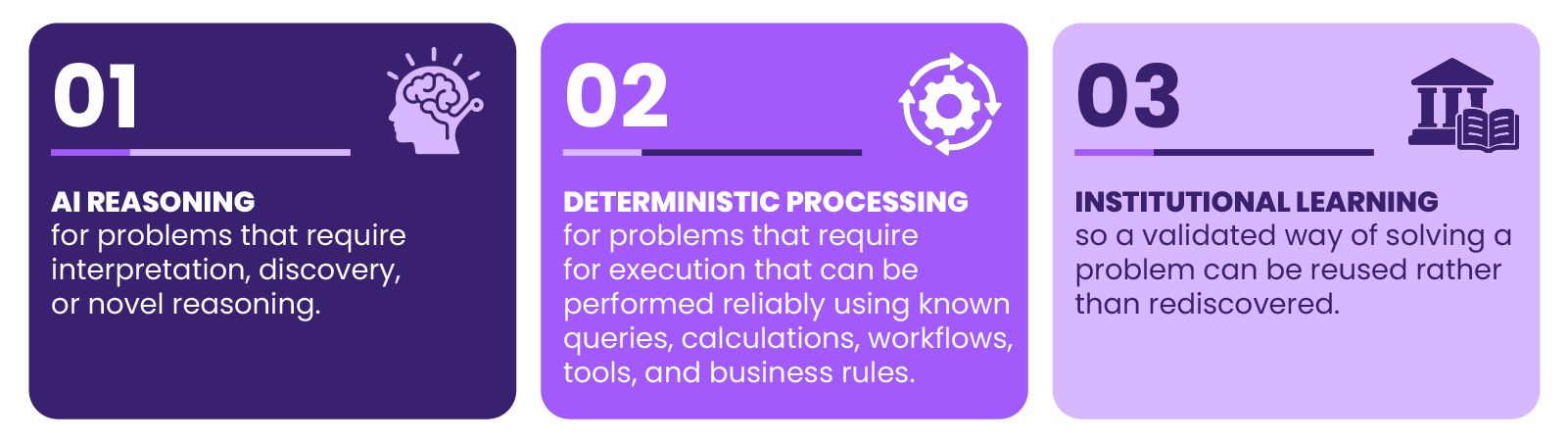
The objective is not to eliminate LLMs. It is to become much more deliberate about when an LLM is required.
Before getting into how that works, we wanted to know whether the architecture changed the economics. So we measured it.
The results from implementing NeoSapients
We evaluated the NeoSapients Cortex Engine path across multiple tasks and questions spanning four levels of complexity, from direct lookups through computed values and detailed listings to multi-step questions.
We compared the full measured cost of executing those requests through the NeoSapients Cortex Engine path, including measurable platform model spend, against the comparison agent configuration.
The result
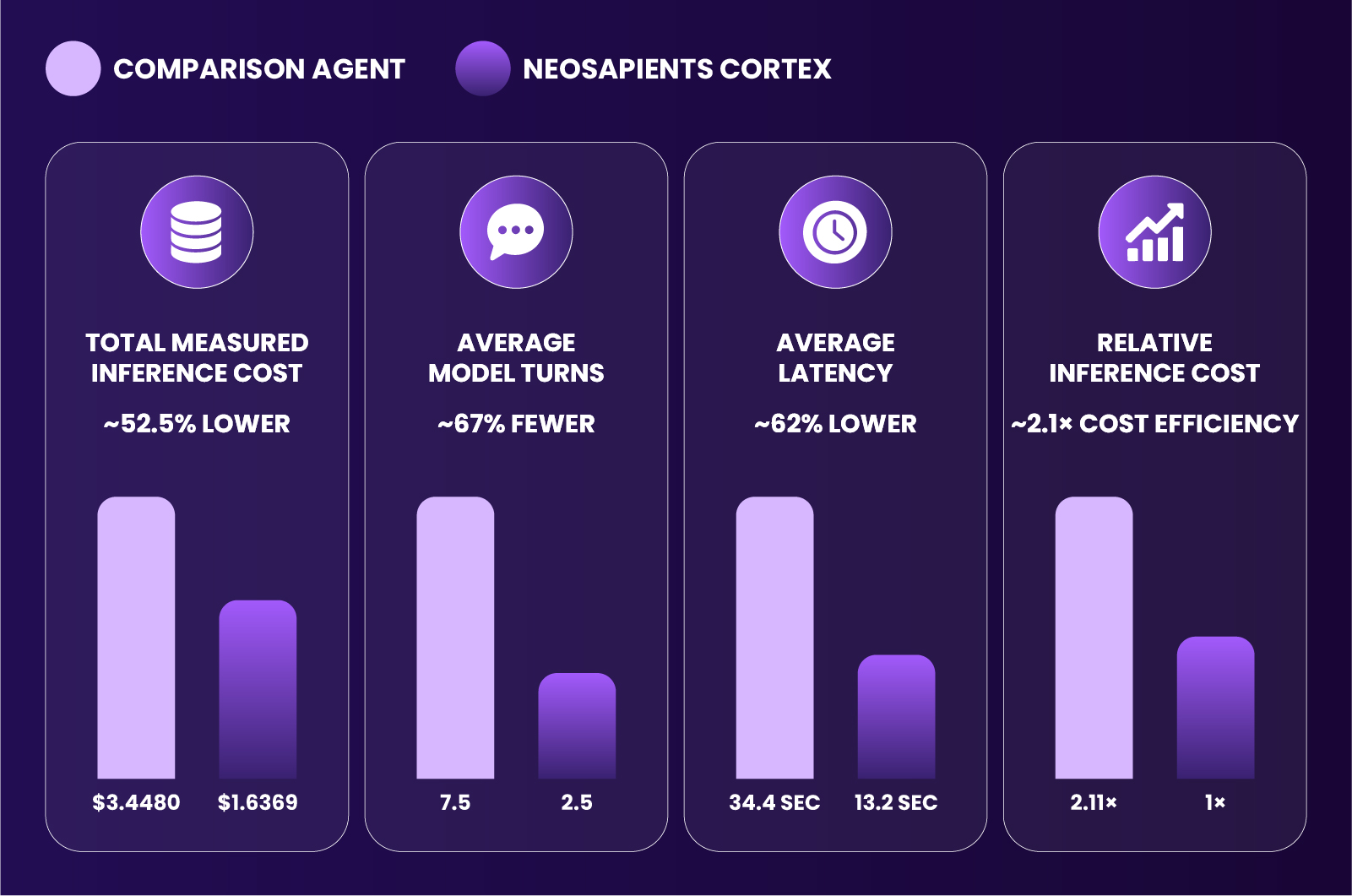
Across the complete test set, the Cortex path recorded $1.6369 in total measured spend compared with $3.4480, while average model turns fell from 7.5 to 2.5.
But the result that interested us most was not the aggregate cost reduction. It was this:
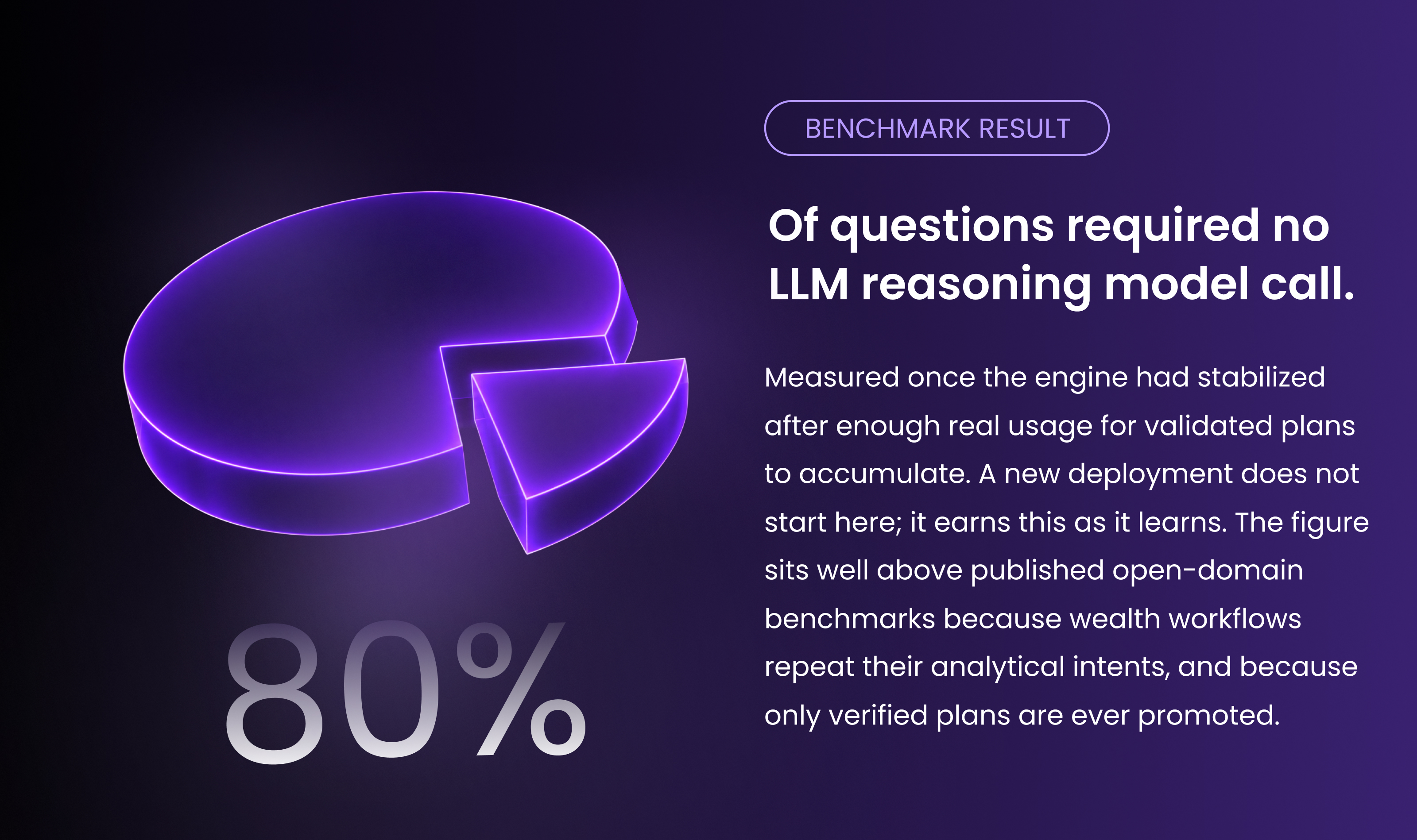
The NeoSapients Cortex Engine already had an approved plan for resolving the request, learned from past usage and user inputs. The platform therefore did not need an LLM at the Cortex layer to rediscover how to solve it. It executed the stored plan directly.
That distinction is important. The platform was not returning an old answer. It was reusing a known way of obtaining the current answer.
How this is possible?
The answer expires. The reasoning doesn't.
Institutional learning means learning from experience. When an organization solves a problem well, that knowledge should not disappear the moment the task ends — it should make the next similar problem cheaper and faster to solve.
Caching is one of the methods used to make that possible, but the common form of it does not qualify. Conventional caching stores the response, and a stored response goes out of date the moment the world moves.
Institutional learning works differently. NeoSapients learns and retains the reasoning that led to an accurate outcome, not the outcome itself. The method persists; the answer is produced fresh every time.
Consider a Wealth Advisor asking:
“How does the current war in Ukraine impact my client portfolio?”
This is not a static question.
To answer it properly, the system may need to:
- Understand the current geopolitical situation
- identify the macroeconomic implications
- determine which sectors, asset classes, commodities, currencies, or regions may be affected
- map those impacts to the client's current holdings
- evaluate concentration and exposure
- identify potential portfolio risks
- explain the reasoning behind those risks.
The situation can change. Market conditions can change. The client's holdings can change. So caching yesterday's answer would make little sense.
But the underlying method for analyzing the question can remain reusable. The platform can retain a validated reasoning plan the technique the research literature calls plan caching such as:
- Assess current event
- identify economic transmission mechanisms
- determine affected sectors and assets
- map those exposures to current client holdings
- evaluate portfolio impact
- surface risks
When a similar question is asked again, NeoSapients does not need to rediscover the complete analytical process from scratch. It can reuse the validated plan while executing it against the latest external context and the client's current portfolio data.
The idea is not ours alone, and that is the point. Stanford researchers formalized it as Agentic Plan Caching at NeurIPS 2025, reporting roughly 50% lower cost and 27% lower latency across agent workloads while holding accuracy steady. Independent research confirms the mechanism works. What NeoSapients has done is operationalize it for regulated industries, where a benchmark result is not enough.
What operationalizing it required
- Validation gating: A reasoning plan is never cached because it ran. It is promoted only after the outcome it produced has been verified as correct. An unvalidated plan is discarded, not reused.
- Per-tenant isolation: Plans are learned and reused within a tenant boundary. One institution's reasoning never becomes another's — a requirement in regulated environments that a shared research cache does not have to answer for.
- Domain depth over open-domain breadth: Open-domain benchmarks see low reuse because the questions rarely recur. Wealth and financial workflows are the opposite: the same analytical intents return constantly. That is why our measured reuse sits far above published benchmark hit rates.
NeoSapients does not simply remember what the answer was. It remembers how to determine the right answer.
Reason probabilistically. Execute deterministically.
LLMs are powerful precisely because they are probabilistic.
That allows them to interpret ambiguous requests, reason about unfamiliar situations, consider alternatives, and work through problems that were never explicitly programmed.
But that same property does not mean every step of an enterprise workflow should remain probabilistic.
Once the system determines that a particular data source must be queried, that query can execute deterministically. Once a calculation has been defined, the calculation can execute deterministically. Once a workflow has been established, the workflow can execute deterministically. Once the applicable business rule has been identified, evaluating the rule does not necessarily require another reasoning cycle.
This gives us a simple architectural principle:
Use AI to determine what should happen. Use deterministic systems to execute what is already known.
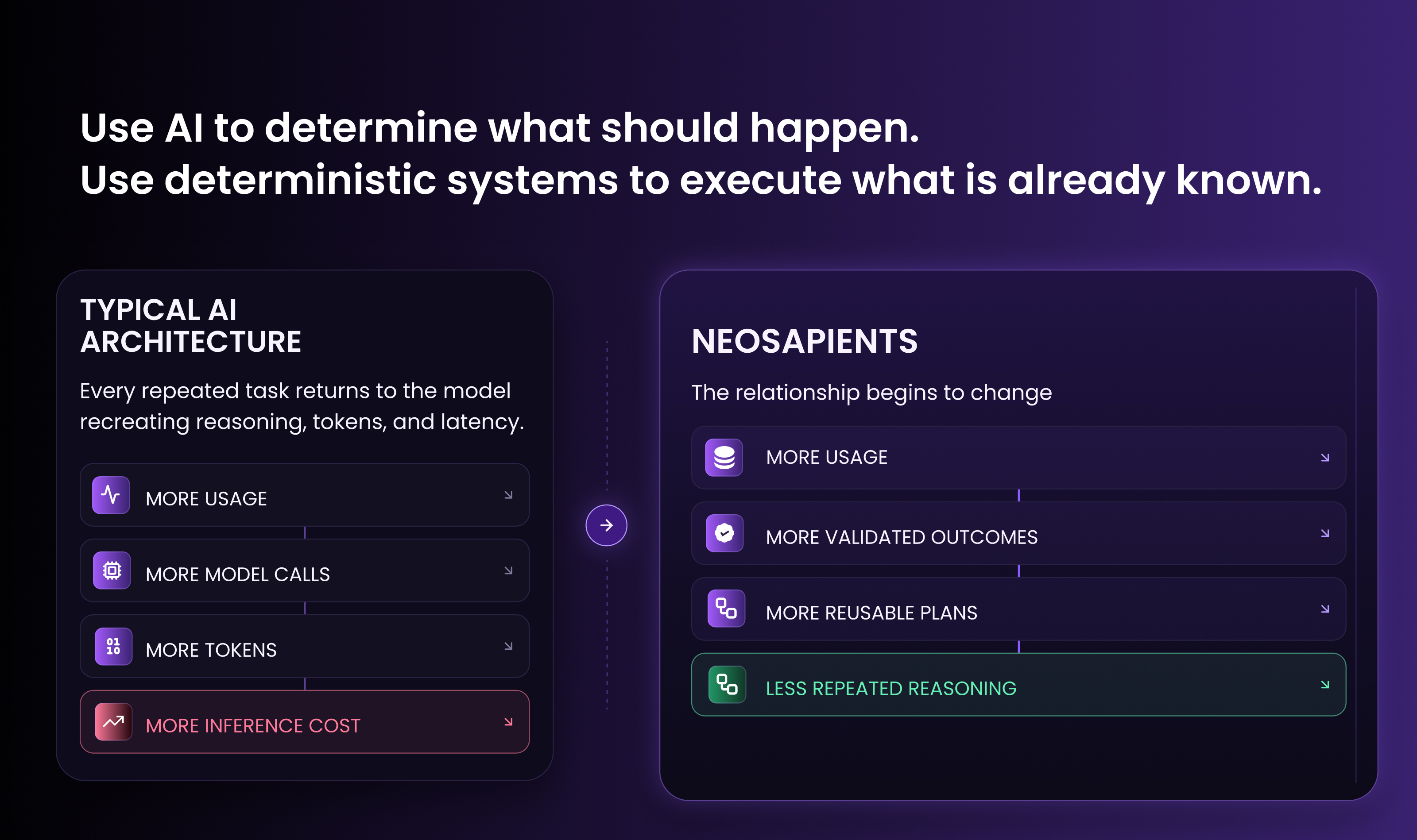
NeoSapients introduces another variable into that equation: learning from previous successful outcomes.
As the platform is used, the Outcome Ledger captures validated outcomes and the reasoning behind them. Reusable ways of performing work can become approved plans, allowing Cortex Engine to execute familiar tasks without repeatedly asking an LLM to rediscover the solution.
Novel problems will continue to require AI reasoning. They should. But as more patterns become familiar and more ways of performing work are validated, a greater proportion of enterprise activity can draw on what the system has already learned. This means scale does not have to translate only into more inference.
With NeoSapients, increased usage can also create more reusable institutional knowledge, giving enterprises the potential to improve inference efficiency as the platform learns.
The system does not just process more work as usage grows. It gets better at knowing which work no longer needs to be reasoned through from scratch.
Enterprise AI should get cheaper as it learns. NeoSapients is designed to make that possible
Most approaches to AI cost optimization focus on making each inference cheaper. NeoSapients addresses a different question: does this task still require fresh inference at all?
When a problem is new, reason. When the enterprise already knows how to solve it reliably, reuse what it has learned.
The most efficient inference call is the one the system has learned it no longer needs to make.
Walk through the Cortex Engine benchmark with our team and map it against your own agent workloads.